
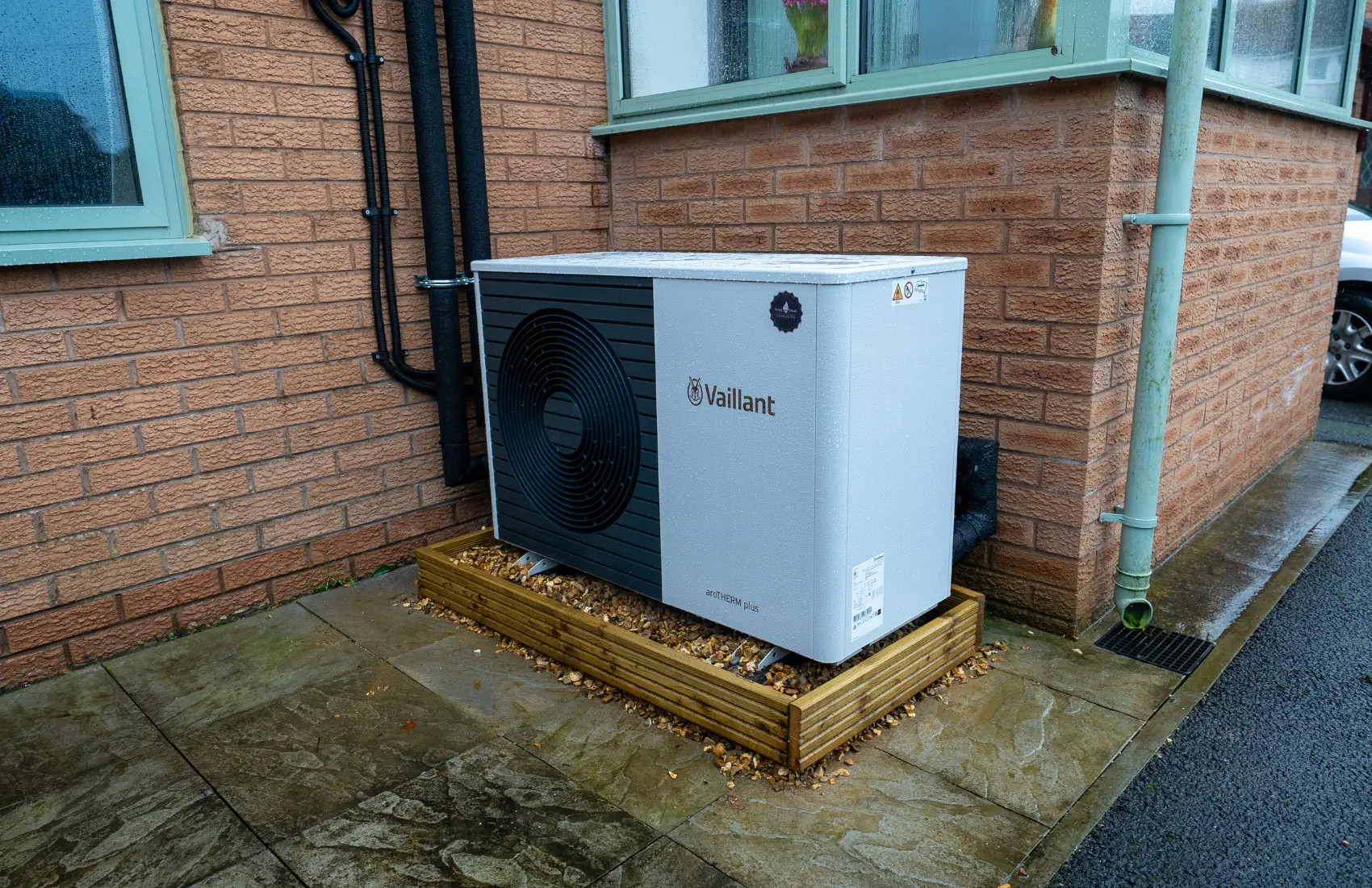
Thinking about replacing your boiler with a heat pump?
It is a big decision, particularly if you have lived with a gas boiler for years and know roughly what to expect from it. A heat pump works differently, so naturally you will have questions about whether it will keep your home warm, whether your radiators will work and what it will cost to install and run.
These are sensible things to look into before making a decision.
The good news is that heat pumps can work very well in UK homes, including many older properties. But the system needs to be properly designed around the house rather than treated as a straightforward boiler replacement.
Here are some of the main things worth considering.
This is usually the first question homeowners ask.
Heat pumps generally operate at lower flow temperatures than gas boilers. That means the heating system needs to be designed to deliver enough heat at those lower temperatures.
It does not mean you have to accept a colder house.
The starting point is understanding how much heat your property actually loses. A proper heat-loss calculation looks at the size of each room, windows, walls, insulation and other factors to establish how much heat is needed.
That information can then be used to size the heat pump and heating system correctly.
Getting this right matters. A system that is too small may struggle to meet the heating demand, while an oversized system can affect efficiency and how the heat pump operates.
So if you are asking whether a heat pump can keep your home warm, the better question is whether the proposed system has been properly designed for your home.
You may have heard that heat pumps always require larger radiators.
That is not necessarily the case.
Because heat pumps normally operate at lower temperatures, radiators may need to be larger to provide the required heat output. Whether yours are suitable depends on the heat loss of each room and the output of the existing radiators at the proposed flow temperature.
Some homes may need several radiators changed. Others may need very few changes.
There is no reason to replace everything automatically.
A good installer should be able to check the radiators individually and explain where changes are actually needed. This is far better than simply telling every homeowner that their entire heating system needs replacing.
And the same principle applies to pipework, controls and other components. The whole system needs to work together.
This is something that often gets overlooked when people first start looking at heat pumps.
If you currently have a combi boiler, you are probably used to getting hot water directly from the boiler whenever you turn on a tap. A heat pump usually works differently.
Most heat pump systems use a hot water cylinder to store domestic hot water. That means you need enough suitable space for the cylinder and the system needs to be designed around your household’s hot water requirements.
For some homes, this is straightforward.
For others, finding the right location for a cylinder may need some thought.
It is worth discussing this at the beginning rather than discovering it when you are already committed to an installation. Your installer should look at your existing hot water arrangements and explain what would need to change.
There is no standard price because every property is different.
The cost can depend on the heat pump itself, the complexity of the installation, radiator upgrades, pipework, hot water requirements, electrical work and any other improvements needed.
There is also financial support available. Eligible homeowners in England and Wales can currently receive £7,500 towards an air source heat pump through the Boiler Upgrade Scheme, subject to the scheme’s requirements.
But the grant is only part of the calculation.
When comparing quotes, look at what is actually included. A low price may look attractive, but it is difficult to compare two installations if one includes everything and the other does not.
Ask what heat pump has been proposed and why. Find out whether a heat-loss calculation has been carried out. Ask whether your radiators have been checked and what will happen with your hot water.
You should know what you are paying for before the work starts.
This is another important consideration.
A heat pump uses electricity rather than gas, so it is reasonable to ask how the change will affect your energy bills.
There is no single figure that applies to every household. Running costs depend on the property, heat pump, electricity tariff, heating requirements and how efficiently the system operates.
System design has a big part to play.
Heat pumps can operate very efficiently when they are working at appropriate temperatures. Correct radiator sizing, suitable flow temperatures, good controls, properly sized pipework and effective commissioning all contribute to how the system performs.
That is why looking only at the efficiency figure of the heat pump itself does not tell you everything.
The installation needs to be considered as a complete heating system.
Your installer should also explain how the system is intended to operate. Heat pumps often work differently from boilers and understanding how to use the heating properly can make a real difference.
Having an older property does not automatically rule out a heat pump.
There are plenty of older UK homes with heat pumps, but the property needs to be assessed properly.
The important question is how much heat the house loses and what needs to be done to provide that heat efficiently.
Insulation can make a difference. So can draughts, windows, radiators and other parts of the building.
You may decide to make improvements before installing a heat pump, or the existing property may already be suitable.
There is no need to assume that an older home will automatically require major renovation. A proper assessment should tell you where improvements would actually make a difference.
The installer matters.
A good heat pump is only part of the finished system. The design, installation and commissioning all affect how it performs once it is heating your home.
When getting quotes, ask some straightforward questions.
How have you calculated the heat loss of my property?
What flow temperature has the system been designed around?
Have you checked my existing radiators individually?
What hot water cylinder will I need?
Will the existing pipework be suitable?
How will the system be commissioned and set up?
The answers can tell you a lot about how much thought has gone into the proposed installation.
Specialist training can also be useful. Heat Geek, for example, provides installer training covering areas including heat-loss calculations, emitter sizing, hydraulics and commissioning.
Ultimately, you want someone who understands the whole heating system and can explain their recommendations clearly.
If you are considering a heat pump but are still unsure whether it is right for your property, speak to us.
We can assess your existing heating system, look at the requirements of your home and talk you through what would actually be involved.
That could mean changing some radiators. It could mean looking at your hot water system or making improvements elsewhere. Or your home may already be well suited to a heat pump.
The important thing is finding out what your property needs before you commit to an installation.
Get in touch today to discuss your heat pump options and find out whether a heat pump could work for your home.
Copyright © JLD Gas & Renewables Ltd. All rights reserved.
Copyright © JLD Gas & Renewables Ltd. All rights reserved.